
Formal System
Language, definitions and theorems
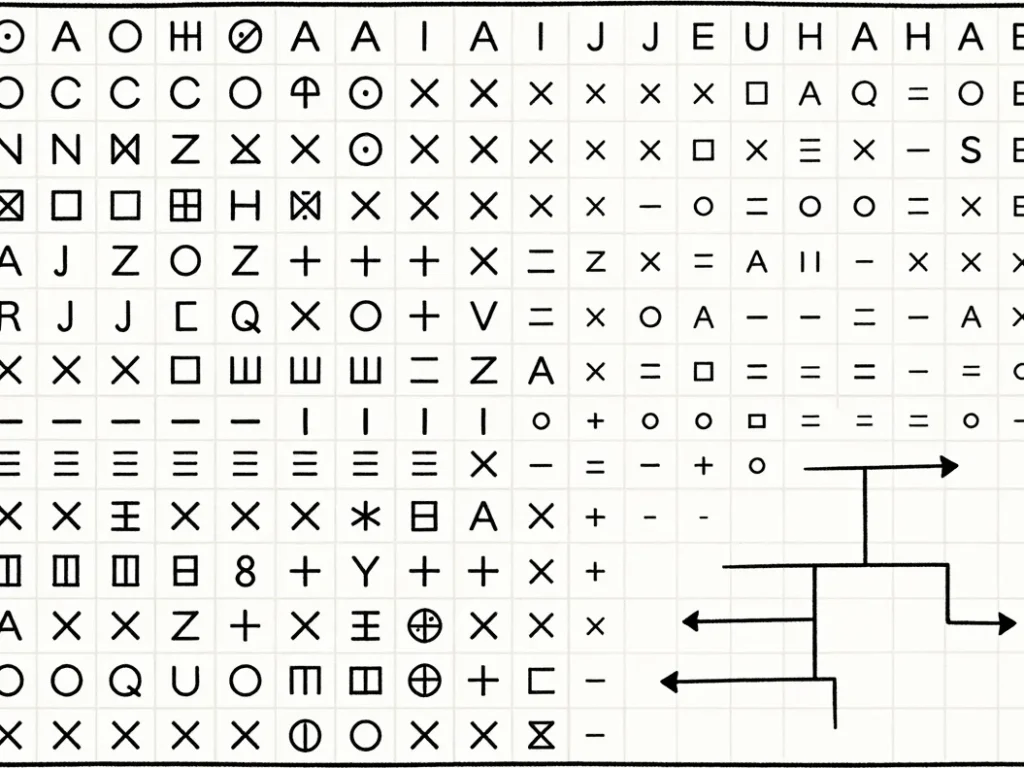
The primitive symbols, definitions, and inference rules that underpin theoretical calculus are presented explicitly for independent examination.
THEORY OF OBJECTIVITY: FROM THE COSMOGONIC THEOREM TO CONVENTIONAL MATHEMATICAL FORMALIZATION
Logical Foundations, Geometrical Structure, and Prospects for Scientific Collaboration
The Theory of Objectivity (TO), developed by Vidamor Cabannas and Denivaldo Silva, presents a complete cosmogonic theorem within its own conceptual and technical language, intended to explain, through a structured sequence of logical and geometrical relations, the necessary conditions for the origin, formation, organization, and existential continuity of the universe.
Its foundations rest upon seven modal axioms, designated the Seven Absolute Truths, which constitute the ontological and logical premises of the theoretical system. From these premises, the Theory develops a deductive architecture integrating modal logic, principles of necessity and possibility, fundamental geometrical relations, and proposed mechanisms governing the differentiation and organization of physical reality.
The cosmogonic theorem of TO thus seeks to establish a logically ordered transition from Logical Nothingness to primordial geometrical determinations, the emergence of relational structures, and the progressive constitution of the physical elements of the universe. This theoretical proposal aims to provide a unified explanation of cosmogenesis by connecting its ontological foundations to geometrical structures and phenomena investigated by contemporary physics and cosmology.
Although the theorem is presented as complete within the Theory of Objectivity’s own conceptual framework, its comprehensive translation into conventional mathematical language remains an essential stage in the scientific development of the research program. In this context, it is important to distinguish the internal completeness of the cosmogonic formulation from a rigorous demonstration of its formal consistency, its correspondence with established physical models, and its ability to generate empirically testable predictions.
In the critical-propositional dialogue studies conducted between the Theory of Objectivity and significant authors, experiments, and theoretical models of modern physics and cosmology, with the analytical assistance of artificial intelligence, preliminary and propositional approaches to converting elements of the cosmogonic theorem into conventional mathematical language have already been introduced.
These exploratory approaches involve the use of structures drawn from formal logic, mathematical geometry, field theory, quantum mechanics, relativity, and theoretical cosmology. Their purpose is to investigate formal correspondences, identify conditions of compatibility, clarify potential divergences, and establish pathways toward mathematical models capable of representing the fundamental propositions of TO with greater precision.
These preliminary developments, however, should not be confused with a complete mathematical formalization, a rigorous demonstration, or definitive scientific validation of the theorem. Rather, they constitute an open research program inviting further development, critical examination, and interdisciplinary collaboration.
Areas of Expertise Particularly Relevant to the Project
To advance this stage of development, the Theory of Objectivity considers the participation of researchers and specialists in the following fields particularly valuable:
1. Modal Logic and Mathematical Logic: To formalize the seven axioms, rigorously define their relations of necessity and possibility, investigate the independence of the premises, and assess the validity of the resulting deductions.
2. Foundations of Mathematics and Proof Theory: To construct a rigorous axiomatic language, identify derived theorems, and examine the consistency and formal properties of the theoretical system.
3. Differential Geometry, Algebraic Geometry, and Topology: To develop mathematical representations of the fundamental geometrical structures proposed by TO, including their relations of boundary, dimensionality, continuity, transformation, and spatial organization.
4. Mathematical Physics and Theoretical Physics: To investigate possible correspondences between the proposed structures and the concepts of fields, particles, energy, fundamental interactions, and physical dynamics.
5. General Relativity, Gravitation, and Mathematical Cosmology: To examine whether the cosmogonic mechanisms proposed by TO can be expressed through dynamical models that are compatible with, or rigorously comparable to, the equations and observations of contemporary cosmology.
6. Foundations of Quantum Mechanics and Quantum Field Theory: To analyze the propositions of TO concerning the constitution of matter, physical information, atomic interactions, and the processes through which physical structures emerge.
7. Theoretical Computer Science and Formal Verification: To develop computational representations of the axioms and verify deductive sequences through proof-assistance systems such as Lean, Coq, or Isabelle.
8. Philosophy of Science, Formal Ontology, and Epistemology: To examine the limits and conditions governing the transition from logical necessity to ontological existence, physical possibility, and experimental confirmation.
Invitation to Scientific Collaboration
The Theory of Objectivity recognizes that the consolidation of a cosmogonic proposal with universal explanatory ambitions requires not only conceptual coherence but also rigorous mathematical formalization, semantic clarity, deductive consistency, empirical compatibility where applicable, and the ability to generate theoretical consequences distinguishable from those established by existing models.
For this reason, the research program welcomes contributions from mathematicians, logicians, theoretical physicists, cosmologists, researchers in the foundations of science, and specialists in computational formalization who are interested in critically examining its premises and collaborating in the translation of its cosmogonic structure into mathematical systems recognized by the scientific community.
The purpose of this collaboration is not to presuppose the validity of the Theory, but to subject it to the most demanding instruments of rational and scientific analysis, identifying which propositions can be formally demonstrated, which depend upon additional hypotheses, which admit consistent physical representations, and which may give rise to predictions suitable for experimental investigation.
The transition from the Theory of Objectivity’s own conceptual language to a conventional mathematical formulation therefore constitutes a decisive frontier of its research program: an effort to integrate logic, geometry, mathematics, and physics through the rigorous investigation of the fundamental conditions underlying the possibility and existence of the universe.
The participation of independent specialists will be particularly valuable in transforming an internally articulated cosmogonic construction into a formal system capable of mathematical demonstration, critical evaluation, scientific comparison, and, wherever possible, empirical verification.
The Theory of Objectivity thus presents its cosmogonic theorem not as a closed conclusion immune to revision, but as a structured theoretical proposition open to examination, refinement, mathematical development, and constructive scientific dialogue.
Its broader ambition is to establish whether a coherent path can be rigorously developed from modal logical necessity to geometrical determination, from geometrical determination to physical possibility, and from physical possibility to experimentally examinable consequences.
—
Vidamor Cabannas and Denivaldo Silva
*Theory of Objectivity — Theoretical Research and Development Program*
Feira de Santana – Bahia, Brazil, 2026
www.teoriadaobjetividade.com.br
*Authors’ Note: The critical-propositional dialogue studies and preliminary mathematical approaches referenced in this text received analytical support from artificial intelligence, particularly ChatGPT. Their interpretation, revision, and scientific validation remain subject to critical examination by qualified researchers and specialists.*
Methodology and authorship
Analytical support and research responsibility
Artificial intelligence-based analytical support is used only for logical consistency verification and notation review. All formulation, theoretical decision-making, and conclusions remain the responsibility of the authors, who are accountable for the integrity and accuracy of the record.
The authorship policy identifies each contribution and keeps a record of versions, so that changes to the fundamentals and formulation can be tracked and challenged.
Analytical support
Inference verification, notation checking, and inconsistency identification, without generating substantive results.
Responsabilidade de pesquisa
The authors are fully responsible for the hypotheses, the evidence presented, and the content published.